- Materials
- clay, local mountain clay, commercial synthetic wood-ash glaze, natural ash glaze, painting, calligraphy
- Techniques
- anagama firing, electric kiln firing, reduction firing, hidasuki, jiggering, wood firing, climbing kiln firing, hikidashi-guro
- Classification
- ceramics
辻村史朗
Shiro Tsujimura was born in Gose, Nara. He began making pottery as a self-taught practitioner in 1971 and, the following year, bought mountain land in Mima, where he built a kiln, studio, tea room, and residence from reclaimed materials. His practice includes ceramics, painting, and calligraphy. [1]
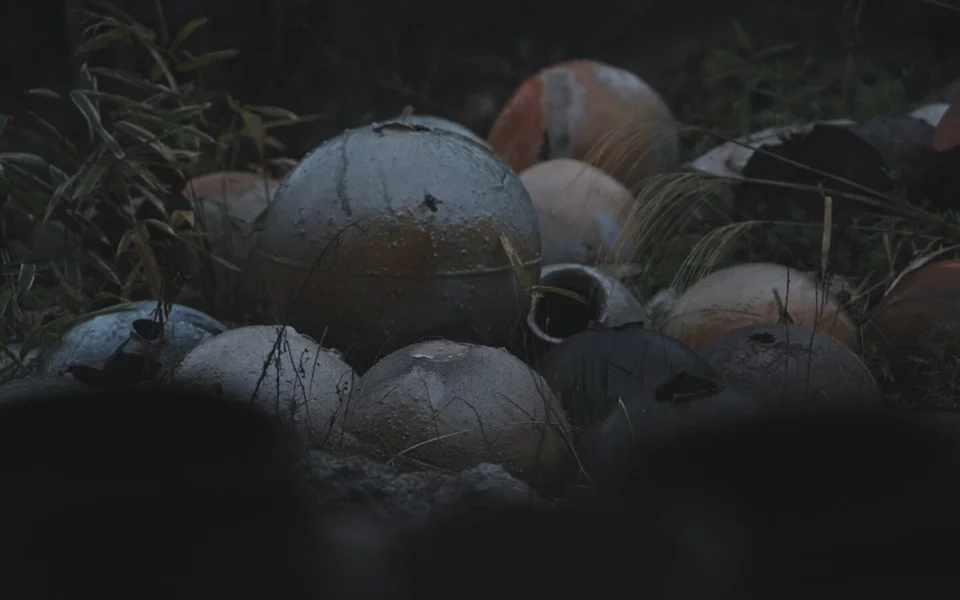
Cluster of ceramic pots among tall grass. · Source: Shiro Tsujimura official archive. · About — Shiro Tsujimura
Profile
Background
Shiro Tsujimura was born in Gose, Nara, into a cattle-farming family and initially wanted to become a painter. As a teenager he went to Tokyo, failed the Tokyo University of the Arts entrance examination, was accepted by Tama Art University but did not enroll, and unsuccessfully sought a painting apprenticeship. He turned toward Zen: in 1967 he entered Sanshoji in Nara and later traveled as an itinerant monk before returning to Tokyo and drawing/painting at an independent art institute.
In 1970 he saw a classic Korean Ido tea bowl at the Japan Folk Crafts Museum, a vessel made by an unnamed craftsman. In 1971 he returned to his family's farm, worked with cattle and milk delivery by day and taught himself ceramics at night using an improvised wheel built from agricultural machinery. Within months he was selling the pots from roadsides and fields around Kyoto.
In 1972 Tsujimura bought roughly a thousand tsubo of remote mountain land at Mima, pitched a tent in winter and, with his future wife, began clearing the site. He taught himself masonry, carpentry and plastering and built the house, tea room, studio and kilns from reclaimed tiles, timber, soil and discarded kiln bricks. By the late 1970s he had built numerous experimental kilns and was treating building, firing, painting, calligraphy, selling and living as one practice.
Practice
Work over time
-
Education Entered the school, continued drawing, and later went to Tokyo hoping to become a painter; the archive does not state a graduation date. · Nara Prefectural Fifth High School · Nara, Nara Prefecture, Japan [1]
-
Art study plans and Zen interest Failed the Tokyo University of the Arts entrance exam, passed the Tama Art University entrance exam but did not enroll, and sought study with artists without success; his interest in Zen arose during this period. · Tokyo, Tokyo, Japan [1]
-
art school entrance Applied to Tokyo University of the Arts and failed, was admitted to Tama Art University but did not enrol, and was refused apprenticeship by painters he approached. [38]
-
Zen novice Began service as a novice at the Soto Zen temple Sanboji in Nara. [38]
-
Residency Entered Sanshoji, a Sōtō Zen temple in Nara, and began monastic training. · Zen training temple: Sanshoji · Nara, Nara Prefecture, Japan [1]
-
Itinerant Zen training Became an itinerant priest in training and traveled in the Tōhoku region, including a one-week mountain retreat near Mount Kurikoma. · Tōhoku, northeastern Japan, Japan · Mount Kurikoma, Miyagi Prefecture, Japan [1]
-
travelling mendicant Became a travelling mendicant monk and walked through the Tohoku region. [38]
-
Education Returned to Tokyo and entered a painting institute in Meguro, studying drawing and oil painting where students also made pottery including tea bowls. · Meguro, Tokyo, Japan [38]
-
Meeting Met Mieko Sugiyama, a native of Akita, while at the Takami Art Research Institute. · future spouse: Mieko Sugiyama [1]
-
Education Entered the institute in Tokyo and focused on sketching and oil painting; he also tried making teabowls and other pottery. No qualification is stated. · Takami Art Research Institute · Meguro, Tokyo, Tokyo, Japan [1]
-
Formative encounter with Korean teabowl At the Japan Folk Crafts Museum in Meguro, he was deeply inspired by a large Korean Oido teabowl made by an anonymous craftsperson. · museum visited: Japan Folk Crafts Museum · Meguro, Tokyo, Tokyo, Japan [1]
-
Kiln Construction Built one of the simplest direct-flame kilns and devised a potter's wheel by attaching a motor to farm machinery. · Gose, Nara Prefecture, Japan [1]
-
Pottery practice begins Resolved to make pottery, returned to Gose, and worked on ceramics while helping with the family cattle-breeding business. · Gose, Nara Prefecture, Japan [1]
-
Selling pottery directly Sold pottery on streets in Kyoto and in the countryside of Ōhara while supporting himself and his household through direct sales. · partner in sales: Mieko Sugiyama · Kyoto, Kyoto, Japan · Ōhara, Kyoto Prefecture, Japan [1]
-
Studio Open Cleared the land and built a home, tea room, and studio with reclaimed lumber, roof tiles, earth, and kiln bricks; the workshop and studio were built over the next two years. · co-builder: Mieko Sugiyama · Mima, Nara Prefecture, Japan [1]
-
Relocation Purchased mountain land in Mima east of Nara and moved there while building a home and work site. · Mima, Nara Prefecture, Japan [1]
-
Kiln Construction Built a kiln in Mima with reclaimed bricks from dismantled Shigaraki climbing kilns. · Mima, Nara Prefecture, Japan [1]
-
Studio Open Bought about 1,000 tsubo of mountain land at Mizuma, Nara, and built a kiln, tea room and house himself from gathered or scavenged tile, timber and plaster. · Mizuma, Nara Prefecture, Japan [38]
-
Marriage Married Mieko Sugiyama. · spouse: Mieko Sugiyama [1]
-
Article published Wrote “Pottery and Heart,” published in issues 293 and 295 of Osaka Shōbō. · magazine publisher: Osaka Shōbō [1]
-
Birth of son Birth of his son Yui, who began ceramic work in 1993. · son: Yui Tsujimura [1]
-
Birth of son Birth of his son Kai, who began ceramic work in 1994. · son: Kai Tsujimura [1]
-
Kiln Construction By this year had built about ten anagama kilns, mostly direct-flame (直焔式), fired from the start with heavy waste oil and without test pieces. [38]
-
Department-store exhibition career After the Mitsukoshi Osaka exhibition, arranged through an introduction from Kōsaku Nukada, his work drew the attention of antique dealer Kingo Kondō, and he went on to exhibit in almost all of Japan's major department stores. · introducer: Kōsaku Nukada · antique dealer: Kingo Kondō [1]
-
Annual solo exhibitions and arhat motifs Held an exhibition of pottery and paintings in Tokyo and thereafter annual solo exhibitions, sometimes seven in a year; after seeing the Five Hundred Arhats at Rakanji temple in Kasai, Hyōgo, he began etching arhat motifs into vases and jars. · Tokyo, Tokyo, Japan · Kasai, Hyōgo Prefecture, Japan [1]
-
Painting practice Turned the outlook pavilion on his property into a painting studio and made hundreds of works with canvas, oil paint, charcoal powder, and kiln ash. · Mima, Nara Prefecture, Japan [1]
-
Travel Travelled to Pakistan with Kōsaku Nukada; afterwards the Silk Road became a major theme in his work. · travel companion: Kōsaku Nukada · Pakistan, Pakistan [1]
-
Encounter with Toyozō Arakawa Met ceramic artist Toyozō Arakawa by chance at Kingo Kondō's shop; Arakawa praised his work and asked to buy an Iga-style flower vase, which Tsujimura declined to sell. · ceramic artist: Toyozō Arakawa · antique dealer: Kingo Kondō [1]
-
International exhibitions His first overseas solo exhibition, in New York, was organized through a project by Hiroshi Sugimoto; he subsequently exhibited in the United States, United Kingdom, Germany, Italy, France, Belgium, and elsewhere. · organizer: Hiroshi Sugimoto [1]
-
Dealer purchase Antique dealer Sōshirō Yabumoto praised his work and purchased several teabowls and vases. · antique dealer: Sōshirō Yabumoto [1]
-
Firing practice Began using an electric kiln and used gas for controlled reduction firing. · Mima, Nara Prefecture, Japan [1]
-
Surface decoration During the west Devon stay he first used etched lines on the surface of his pottery and added Oribe-style decoration. · West Devon, Devon, United Kingdom [1]
-
Calligraphy practice Began practicing calligraphy. · Mima, Nara Prefecture, Japan [1]
-
Teaching Presented a slide lecture about his pottery at The Metropolitan Museum of Art and the San Francisco Museum of Modern Art. · lecture venue: The Metropolitan Museum of Art · lecture venue: San Francisco Museum of Modern Art [1]
-
Forming technique Began making round jars with a jigger-and-jolly apparatus. · Mima, Nara Prefecture, Japan [1]
-
Collector visit Belgian interior designer and collector Axel Vervoordt visited his home. · collector and gallerist: Axel Vervoordt · gallery: Axel Vervoordt Gallery [1]
-
Solo exhibition and demonstration At his solo exhibition in Paris, President Jacques Chirac spent several hours observing his electric-wheel demonstration. · Paris, Île-de-France, France [1]
-
Residency Took part in a one-week residency in Cologne for the two-person exhibition with photographer Nobuyoshi Araki; the exhibition ran from October 29, 2011 to March 5, 2012. · exhibiting collaborator: Nobuyoshi Araki · Cologne, North Rhine-Westphalia, Germany [1]
-
Jar exhibitions Presented exhibitions of jars in Paris and Nancy, France, and in New York; the New York exhibition was praised in The New York Times on November 2. · Paris, France · Nancy, France · New York, United States [1]
-
Demonstration and firing adaptation Presented a pottery demonstration and exhibition in Victoria, Australia, using lemongrass rather than rice straw for hidasuki fire markings. · Victoria, Victoria, Australia [1]
-
Works on paper Began working with Kami Ya Co., Ltd., which supports his paper works; from then on he used authentic Japanese and Chinese papers and Qing-dynasty sumi ink. · supporting gallery: Kami Ya Co., Ltd. [1]
-
Black teabowl series Produced a large series of black teabowls through repeated making and firing, then exhibited the bowls in Tokyo in February 2016. · Tokyo, Tokyo, Japan [1]
-
Calligraphy performance Presented his first public calligraphy performance in Antwerp. · Antwerp, Antwerp Province, Belgium [1]
-
Residency While staying in Sydney, took part in a three-day pottery-making session with his son Kai at the University of Sydney. · collaborator and son: Kai Tsujimura · residency host: University of Sydney · Sydney, New South Wales, Australia [1]
-
Television profile Featured in the NHK series The Professionals in an episode titled “Creation is Life: Shiro Tsujimura, Ceramic Artist.” · broadcaster: NHK [1]
-
Shino-style teabowls Began Shino-style teabowls in 2021; in 2022 he used more than 150 kg of the glaze and unloaded his kiln thirty-two times between New Year's Day and early March. [1]
-
Kiln Construction Built a kiln during a three-month stay in west Devon. · West Devon, Devon, United Kingdom [1]
-
Kiln Construction By 1977 he had built around ten kilns, primarily direct-firing anagama or cave-type kilns using waste oil, and experimented with how slope, size, and form affected firing. · Mima, Nara Prefecture, Japan [1]
-
Residency Spent three months in west Devon building a kiln and making teabowls, vases, and other pottery. · West Devon, Devon, United Kingdom [1]
Bibliography
- Shiro Tsujimura: An Art of Living · 2024 · monograph
- Hand-sewn catalogue for the 1977 exhibition on the artist's property · 1977 · exhibition catalogue
Collections
- owned holding — MOA Museum of Art: The artist's official chronology says he donated fifty kohiki slipware teabowls to the museum; it does not provide accession numbers or a current object list. · acquired 1984 · claim scope: Official chronology's 1984 donation statement [1]
- owned holding — Cleveland Museum of Art: The artist's chronology records a purchase of his work for the museum's permanent collection, and the museum also appears in his official public-collection list; neither names the object or accession. · acquired 1987 · claim scope: Official chronology's 1987 purchase statement [1]
- owned holding — Spencer Museum of Art: The artist's chronology records the museum's purchase of a large jar, and the museum also appears in his official public-collection list; no accession number is stated. · acquired 1991 · claim scope: Official chronology's 1991 purchase statement [1]
- owned holding — Spencer Museum of Art, University of Kansas: Large pot, museum purchase. [41]
- owned holding — Spencer Museum of Art, University of Kansas: Faceted flower vase, museum purchase. [42]
- owned holding — 樹下美術館: The museum's own blog says it holds Tsujimura works and a flat teabowl by his son Yui; no accession numbers are given. [45]
Evidence and sources
References
- About — Shiro Tsujimura, Profile, public collection list, and chronology Retrieved 2026-09-25
- Shiro Tsujimura Exhibition — official artist archive, Exhibition dates, venues, and artist-selected tea bowls Retrieved 2026-09-25
- Shiro Tsujimura works — imura art gallery
- Shiro Tsujimura biography — imura art gallery
- Shiro Tsujimura — Ippodo Gallery
- Catalog — HAKU marunouchi
- 辻村史朗展 catalogue — CiNii Books
- Shiro Tsujimura — The Gallery by Odo, 2026
- Tea bowl (Shino style) — Princeton University Art Museum
- Shiro Tsujimura — Axel Vervoordt
- To be an artist. To think like a monk — Axel Vervoordt
- Echoes of Nature, Artistry of Self — Axel Vervoordt
- Shiro Tsujimura — Axel Vervoordt 2022
- Jar — The Metropolitan Museum of Art
- Tea bowl — The Metropolitan Museum of Art
- Sake Bottle — The Metropolitan Museum of Art
- Black tea bowl — The Metropolitan Museum of Art
- Gourd-shaped water jar — The Metropolitan Museum of Art
- Tea bowl, 1998 — The Metropolitan Museum of Art
- Shino tea bowl — The Metropolitan Museum of Art
- Ido tea bowl — The Metropolitan Museum of Art
- Square Plate — The Metropolitan Museum of Art
- Calligraphy — The Metropolitan Museum of Art
- 不ニ / Funi — Shiro Tsujimura Collection, gallery yamahon
- Shiro Tsujimura — yamahon online store
- Haku Marunouchi
- Shiro Tsujimura Tea Bowl Exhibition — HAKU marunouchi
- Korean Buncheong Ceramics — Met publication PDF
- Teabowl, 1984 — Cleveland Museum of Art
- Large Jar — Cleveland Museum of Art
- Shigaraki Tea Bowl — Brooklyn Museum
- Drinking Alone by Moonlight — Brooklyn Museum
- Jar, 1997 — British Museum
- Tea bowl (Ido style) — Princeton University Art Museum
- 辻村史朗 土展 — official exhibition record
- 辻村史朗展 — imura art gallery, 2022
- 井戸茶碗 — Art Platform Japan / Aichi Prefectural Museum of Art
- 辻村史朗 Shiro Tsujimura — About(Profile / Chronology) Retrieved 2026-10-02
- 辻村史朗 掲載情報 - Kami Ya Retrieved 2026-10-02
- Shiro Tsujimura's Exploded Forms (Tricycle, Sarah Fleming, 18 July 2025) Retrieved 2026-10-02
- large pot, Tsujimura Shiro (Spencer Museum of Art) Retrieved 2026-10-03
- faceted flower vase, Tsujimura Shiro (Spencer Museum of Art) Retrieved 2026-10-03
- 辻村史朗さんに”酒場”で学ぶ 名碗の勘どころ「井戸茶碗」(前編) (メノメオンライン, 2024-12-30) Retrieved 2026-10-03
- クラプトンやデ・ニーロを顧客に持つ陶芸家はモノづくりとともに生きている (JBpress autograph, 2/3) Retrieved 2026-10-03
- NHKのプロフェッショナルで辻村史朗氏を観た 樹下美術館の辻村作品 (樹下のひととき, 2021-06-16) Retrieved 2026-10-03
- 滿山的茶碗 (Michelin Guide Macau, 美味尋真, 2018-06-07) Retrieved 2026-10-03
- 辻村史朗さんに「酒場」で学ぶ 名碗の勘どころ「井戸茶碗」(後編), 目の眼 Retrieved 2026-10-03
- Taiyo no. 337 (September 1989), Heibonsha: feature on Shiro Tsujimura, pp. 133-136 (scan hosted by Kami Ya) Retrieved 2026-10-03
- Mrs. (ミセス) January 2014 no. 709, Bunka Publishing Bureau: 墨色のアート 辻村史朗の書 (scan hosted by Kami Ya) Retrieved 2026-10-03
- Nagomi, January 2019 (no. 469), Tankosha: 陶芸家・辻村史朗 大井戸茶碗 銘「対馬」を観る (scan hosted by Kami Ya) Retrieved 2026-10-03
- Shiro Tsujimura, Art in Review, Holland Cotter, The New York Times, 2012-11-01 (Wayback copy) Retrieved 2026-10-03
- 企画展「辻村史朗 −茶盌」, ZENBI Kagizen Art Museum Retrieved 2026-10-03
- NHK プロフェッショナル 仕事の流儀「作ることが、生きること 陶芸家・辻村史朗」 Retrieved 2026-10-03
- NHK Nichiyo Bijutsukan 'Tou no yama: Tsujimura Shiro' (24 July 2022), summary on Chotto bijutsukan made Retrieved 2026-10-03
- [Museum 'Eki' KYOTO] Ceramist Shiro Tsujimura exhibition, press release (JR West Isetan, 17 Feb 2022) Retrieved 2026-10-03